
Digital Marketing Strategy: How to Build a Growth System That Actually Works
17 min read
Digital marketing becomes expensive when every channel operates independently.
SEO publishes content without knowing what converts.
Paid media sends traffic to pages that were never designed for the campaign.
Social media produces content because the calendar needs filling.
Email follows its own plan.
The website sits in the middle receiving all that traffic without a clear conversion strategy.
Every team may be busy, but the system is not necessarily moving the business forward.
A strong digital marketing strategy fixes that disconnect.
It defines the audience, commercial objective, positioning, channel roles, customer journey, measurement and priorities that should guide marketing activity. Instead of treating SEO, paid advertising, social media, content and conversion as separate tactics, it makes them work together.
At FWRD, Digital Marketing combines creative execution with performance thinking so campaigns, content and digital experiences support the same broader business goals.
This guide explains how to build a digital marketing strategy from the ground up, how the main channels should work together and how to turn marketing activity into a system that can learn, improve and scale.
1) What is a digital marketing strategy?
A digital marketing strategy is the plan that connects your business goals with the audiences, channels, messages and digital experiences required to achieve them.
It should answer several basic questions.
What are we trying to achieve? Who are we trying to reach? What do they need? Where do they spend time? What should they understand about us? Which channels are best suited to each stage of the journey? What happens after somebody clicks? And how will we know whether the strategy is working?
Without those answers, digital marketing tends to become a collection of activities.
A company runs Google Ads because competitors are doing it. It posts on LinkedIn because someone said it should. It starts a blog because SEO matters. It launches email campaigns because there is a database available.
None of those activities are inherently wrong.
The problem is that they may not be working towards the same commercial outcome.
Strategy gives those tactics a reason to exist together.
2) Digital marketing strategy vs digital marketing tactics
Strategy and tactics are related, but they are not the same thing.
A tactic might be:
- Launching a Google Search campaign.
- Publishing four articles per month.
- Running Meta retargeting.
- Posting on LinkedIn three times per week.
- Building an email nurture sequence.
A strategy explains why those tactics matter, which audience they serve and how they connect to the customer journey.
For example, “publish more blog posts” is not a strategy.
“Build organic authority around the problems our highest-value customers search for, then connect that content to commercial service pages and lead capture” is much closer.
Likewise, “increase Meta spend” is not a strategy.
“Use paid social to test message-market fit, identify high-performing creative territories and generate demand among audiences that are not actively searching yet” gives the activity a strategic role.
The distinction matters because tactics can change quickly.
The strategy should remain stable enough to guide those changes.
3) Start with the business objective
Marketing should begin with a business problem rather than a channel.
That sounds obvious, but many strategies begin with questions such as:
“Should we do SEO?”
or:
“Should we increase paid spend?”
A better starting point is:
“What does the business need marketing to achieve?”
A new company may need awareness and demand generation.
An established B2B business may need more qualified enquiries.
An ecommerce company may need to improve customer acquisition efficiency.
Another business may have sufficient traffic but weak conversion.
A subscription company might care more about retention than acquisition.
Those goals require different marketing systems.
Before discussing channels, define the commercial objective clearly enough that marketing can be evaluated against it.
Examples might include increasing qualified pipeline, growing ecommerce revenue, entering a new market, reducing reliance on paid acquisition or improving conversion from existing traffic.
The clearer the objective, the easier it becomes to decide what marketing should actually do.
4) Define the audience before choosing the channels
A channel strategy should come from customer behaviour rather than preference.
If your audience actively searches for the service you provide, search becomes strategically important.
If customers do not yet know the category exists, search demand may be limited and paid social, content or partnerships may need to create awareness first.
A B2B decision-maker researching a complex purchase behaves differently from someone choosing a consumer product.
Understanding that behaviour means going beyond demographic information.
You need to know what customers are trying to achieve, what frustrates them, what creates urgency, what alternatives they consider and what questions appear before they make a decision.
You should also understand where information comes from.
Do they use Google? LinkedIn? YouTube? Industry publications? Instagram? Reviews? Communities? Email newsletters?
The objective is not to be everywhere.
It is to appear in the places that meaningfully influence the decision.
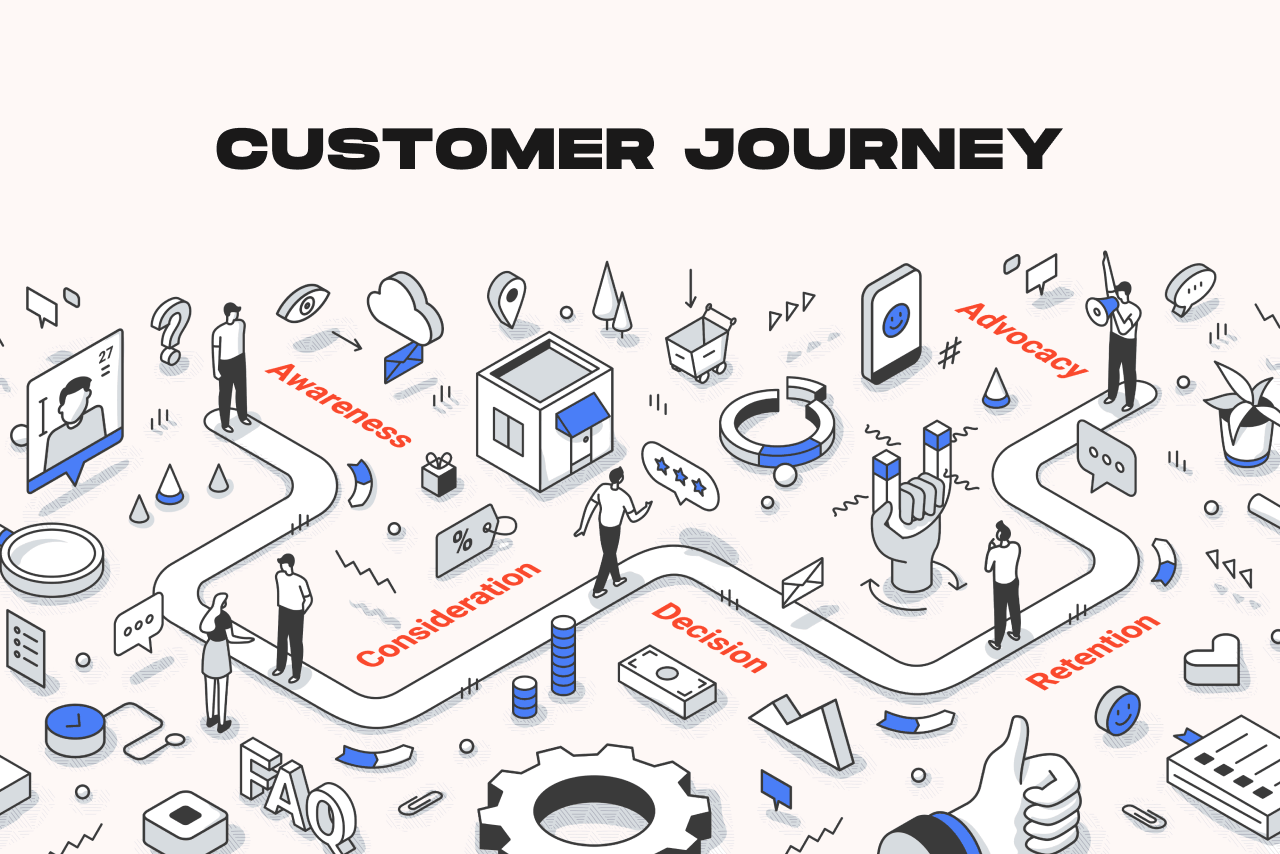
5) Map the customer journey
Most customers do not encounter one ad and immediately buy.
The journey is usually more complicated.
Someone might first discover the company through social content, search the brand several weeks later, read a case study, leave, return through a retargeting ad, subscribe to email and finally contact sales.
Another customer might begin with a high-intent Google search and convert during the first visit.
Digital marketing strategy needs to account for both.
A simple journey can be divided into four broad stages:
| Stage | Customer Need | Typical Marketing Role |
|---|---|---|
| Awareness | Understand that a problem or opportunity exists | Social, video, paid reach, content |
| Consideration | Explore possible solutions | SEO, guides, service pages, case studies, retargeting |
| Conversion | Decide whether to act | Landing pages, proof, offers, sales, CRO |
| Retention | Continue the relationship | Email, CRM, support, content, remarketing |
Real customer journeys are rarely this neat.
The framework is still useful because it prevents the organisation from expecting every channel to perform the same job.
A top-of-funnel video should not be judged exactly like a high-intent search campaign.
6) Positioning and messaging come before traffic
More traffic does not fix unclear positioning.
It simply exposes more people to the confusion.
Before increasing acquisition, make sure customers can understand what the business offers, who it is for, why it matters and what makes it different.
This is where marketing connects directly with brand strategy.
Our Brand Strategy guide explains the broader strategic foundation, while the Brand Messaging Strategy goes deeper into how positioning becomes customer-facing language.
Marketing then distributes and tests that message.
If paid ads consistently perform better around one customer problem, that is useful feedback.
If organic search behaviour reveals that customers use different terminology from the internal team, that is useful feedback too.
Strong digital marketing does not simply broadcast brand strategy.
It helps the business learn whether that strategy is connecting with the market.
7) Give each marketing channel a specific job
One of the most useful things a digital marketing strategy can do is define the role of each channel.
Different channels have different strengths.
SEO is particularly effective at capturing existing search demand and building visibility over time.
Paid search can capture high-intent demand immediately.
Paid social can create reach, test creative ideas and generate demand among audiences that may not yet be searching.
Organic social helps build familiarity, authority and ongoing audience connection.
Content gives the brand useful material to educate, rank, persuade and nurture.
Email and CRM allow the company to continue the relationship after the first interaction.
The website and landing pages convert all of that attention into action.
The strategy becomes much stronger when these channels are designed to support one another.
If you are specifically deciding how SEO and paid acquisition should work together, our existing SEO vs Paid Ads guide covers that decision in more depth.
8) The website is part of the marketing system
Traffic acquisition receives a lot of attention because spend and impressions are easy to see.
But the website determines what happens after the click.
If campaigns are working but the landing experience is confusing, the marketing system is still weak.
The site needs to answer the questions created by the campaign.
What is this? Is it relevant to me? Why should I believe it? What happens next?
That means positioning, page structure, copy, proof, mobile usability, speed and calls to action are all marketing considerations.
A paid campaign sending highly qualified traffic to a weak page does not have a traffic problem.
It has a conversion problem.
The same principle applies to organic traffic.
Ranking well for an important keyword creates an opportunity. The page still needs to help the visitor understand the offer and move forward.
FWRD's Website Design work connects brand expression with usability and conversion rather than treating the website as a static marketing asset.
If the wider website itself needs rebuilding, our Website Redesign guide covers the UX, conversion and SEO considerations involved.
9) SEO should capture valuable demand, not simply traffic
SEO is often reduced to rankings and publishing frequency.
That misses the commercial point.
A useful SEO strategy identifies the searches that matter to the business and builds the technical, structural and content foundation required to become visible for them.
Some keywords indicate immediate commercial intent.
Others represent customers researching a problem long before they are ready to buy.
Both can matter.
The role of strategy is determining which topics deserve investment and how those pages connect to the rest of the site.
Good SEO usually requires three layers.
First, the technical foundation needs to allow search engines to crawl, understand and index the website properly.
Second, pages need to match search intent.
Third, the site needs enough authority and internal structure for important pages to compete.
FWRD's Performance Optimisation & SEO work addresses that broader system rather than treating SEO as isolated blog production.
SEO becomes particularly valuable when content is organised around genuine areas of commercial expertise.
That is also why we build topic clusters instead of publishing unrelated articles.
10) Paid media should buy learning as well as traffic
Paid marketing can generate demand and conversions quickly.
It can also generate expensive noise.
The difference usually comes from what the business learns.
A good paid media programme should help identify which audiences respond, which messages create interest, which offers generate action and where the customer journey breaks down.
That learning can then improve the wider marketing system.
Strong ad hooks can inform landing-page messaging.
High-converting search queries can influence SEO priorities.
Repeated customer objections can become content topics.
Creative performance can reveal which parts of the proposition are easiest for the market to understand.
Paid media therefore has value beyond the immediate conversion.
It provides a fast feedback loop.
FWRD's Paid Marketing work combines targeting, creative and performance optimisation so campaigns can be improved as evidence accumulates.
The objective should not simply be spending more.
It should be learning what allows spend to scale efficiently.
11) Social media should build familiarity, not just fill a calendar
Social media strategy often becomes a publishing problem.
The team asks:
“What are we posting this week?”
A stronger question is:
“What do we want our audience to consistently associate us with?”
Social media can demonstrate expertise, show the people behind the business, build community, distribute content, support campaigns and create repeated exposure to the brand.
Those roles vary by platform.
LinkedIn may be useful for B2B expertise and company visibility.
Instagram may be stronger for visual storytelling, products and brand personality.
TikTok or short-form video can create discovery through more native, entertainment-led formats.
YouTube can support deeper education and search behaviour.
The strategy should decide which roles matter rather than forcing every company onto every platform.
FWRD's Social Media Management work adapts content to the platform while keeping it connected to the broader brand and audience.
12) Content marketing should create useful commercial authority
Content works best when it answers questions relevant to the customer journey and supports areas the business genuinely wants to own.
Random blogging rarely achieves that.
A useful content strategy might include educational guides, comparison articles, commercial decision content, case studies, video, social posts and email.
The format matters less than the strategic role.
Some content should capture search demand.
Some should help potential customers evaluate options.
Some should demonstrate expertise.
Some should remove objections.
Some should make existing customers more successful.
The strongest pieces can often do several jobs.
A substantial guide may rank organically, provide material for social posts, become part of an email sequence, support sales conversations and generate retargeting audiences.
That is much more valuable than treating each channel as requiring entirely separate content.
13) Email and CRM turn acquisition into a relationship
Not every visitor is ready to buy during the first session.
That makes email and CRM important parts of the digital marketing system.
A prospect may need education, proof, timing or several interactions before acting.
Email gives the organisation a way to continue that journey without repeatedly paying to reacquire the same attention.
The role differs by business.
B2B companies may use nurture sequences, case studies and sales follow-up.
Ecommerce businesses may use welcome flows, abandoned-cart messages, product education, post-purchase content and reactivation campaigns.
Subscription companies may focus more heavily on onboarding and retention.
The important point is that CRM should not operate as a separate communication universe.
The value proposition, tone and customer promise should remain connected to the advertising and website experience that originally acquired the customer.
14) The channels should feed information into one another
The strongest digital marketing systems learn across channels.
Paid media can reveal messaging quickly.
SEO can identify persistent customer demand.
Search queries can expose the terminology customers naturally use.
Social engagement can reveal topics that create interest.
Sales conversations show where prospects still need reassurance.
Customer support exposes recurring friction after purchase.
CRM reveals which messages keep customers engaged.
Those insights should not remain inside individual dashboards.
A business becomes much smarter when the information flows across teams.
For example, a high-performing paid message might become a new landing-page headline.
A recurring sales objection might become an SEO article.
A successful educational article might become a social series.
A high-engagement social topic might become a webinar or lead-generation asset.
This is where digital marketing starts becoming a system rather than a group of channels.
15) Build measurement around decisions
Marketing measurement should help the business make better decisions.
More dashboards do not automatically create better understanding.
Start by deciding what the business needs to know.
At acquisition level, that may include cost per lead, customer acquisition cost, ROAS or qualified pipeline.
At website level, conversion rate and landing-page performance may matter.
For SEO, organic conversions and the performance of strategically important pages are usually more meaningful than ranking counts alone.
For social, engagement quality, reach among relevant audiences, traffic and assisted conversion may matter more than follower growth in isolation.
At a business level, blended acquisition cost, revenue, lifetime value, retention and contribution margin can provide a much more useful view than channel metrics alone.
The key is to distinguish between metrics that explain activity and metrics that explain business impact.
16) Attribution will never tell the entire story
Customers interact with multiple channels.
That makes attribution difficult.
Someone might discover a brand on Instagram, later read a blog article through Google, return directly, see a retargeting ad and then convert after an email.
Which channel gets the credit?
The answer depends on the attribution model.
That is why marketing teams should avoid treating platform-reported conversion numbers as an unquestionable version of reality.
Attribution tools are useful.
They are still models.
Look at both channel-level data and the overall commercial picture.
Is total revenue growing?
Are qualified enquiries increasing?
Is customer acquisition becoming more efficient?
Is branded demand increasing?
Are customers arriving better informed?
Good measurement combines platform data, analytics, CRM information and business outcomes rather than asking one dashboard to explain everything.
17) Understand the economics before scaling
Growth is not the same as profitable growth.
Before increasing marketing spend, understand the economics behind acquisition.
For ecommerce, that might mean average order value, gross margin, repeat purchase rate and lifetime value.
For B2B, it may mean average deal value, close rate, sales-cycle length and customer retention.
A channel that appears expensive at first conversion may become extremely valuable if it consistently produces higher-value customers.
The opposite can also happen.
Cheap leads are not necessarily useful if sales never closes them.
This is why marketing and commercial teams need shared metrics.
The objective is not the lowest possible cost per click.
It is acquiring customers in a way the business can sustain.
18) Creative testing should answer questions
Creative testing is most useful when each test has a reason.
Do not simply produce endless variations.
Test strategic questions.
Does the audience respond more strongly to the problem or the outcome?
Does customer proof outperform a product-led message?
Does demonstration work better than explanation?
Does a specialist positioning angle outperform a broader one?
Different visual and copy executions can then explore those questions.
When a clear winner emerges, the learning should be documented and used beyond the original campaign.
This creates accumulated marketing knowledge.
Without that process, teams often run hundreds of creative variations while learning surprisingly little about the customer.
19) Budget should follow opportunity, not habit
Many organisations allocate marketing budget according to historical percentages.
SEO gets one amount.
Paid search gets another.
Social gets whatever remains.
A stronger approach connects budget with the role each channel plays and the evidence available.
If paid search is capturing highly profitable existing demand, it may deserve additional investment.
If SEO has strong demand but poor visibility, there may be an opportunity to build a long-term acquisition asset.
If social content is creating reach but very little movement deeper into the customer journey, the answer may be improving the strategy rather than simply increasing production.
Budget decisions should also consider time horizon.
Paid media can scale traffic quickly.
SEO takes longer to compound.
Brand and content effects may take longer to become visible.
That does not make slower channels less valuable.
It means they need to be evaluated according to the job they are expected to perform.
20) B2B and B2C strategies should not look identical
The strategic principles remain similar, but the customer journey can be very different.
B2B marketing often involves longer buying cycles, several decision-makers and more need for education or proof.
Search, LinkedIn, thought leadership, case studies, email nurture and sales enablement can therefore play particularly important roles.
Consumer and ecommerce marketing often operates with shorter decision cycles and larger volumes of potential customers.
Creative testing, paid social, product merchandising, email, search and conversion optimisation may carry more weight.
Neither approach is inherently simpler.
The important thing is matching the marketing system to the way customers actually buy.
A strategy built for a low-consideration ecommerce product should not simply be copied onto a six-month enterprise sales cycle.
21) Real-world example: connecting marketing, content and lead generation
B Capital Group shows what happens when marketing is treated as a connected system rather than a collection of isolated channels.
The company already had an online presence, but website infrastructure, campaign activity and organic publishing were operating separately.
FWRD strengthened the digital foundation, introduced dedicated campaign landing pages, improved technical SEO and replaced boost-led activity with more structured Meta campaigns.
Organic publishing across Meta and LinkedIn became more consistent, while lead-generation flows and lightweight CRM functionality connected marketing activity more directly with enquiries.
Explore the B Capital Group case study.
The important lesson is not that every business needs the same combination of tactics.
It is that traffic, content, landing pages and lead handling work better when they are designed as one journey.
A strong campaign can generate attention.
The rest of the system determines what happens to it.
22) Real-world example: marketing across acquisition and retention
School of Visual Storytelling demonstrates another side of digital marketing strategy.
SVSLearn already had an established educational platform and audience, but its growth challenge included both acquiring new members and reducing churn.
FWRD's wider work connected the refreshed brand and website with paid advertising across Meta and Google, CRM activity designed to reacquire previous customers, and authority-focused video content.
Explore the School of Visual Storytelling case study.
This is important because digital marketing is often discussed almost entirely in terms of acquisition.
But growth also depends on what happens after the initial conversion.
A strategy that continually acquires customers while ignoring retention can become increasingly expensive.
Marketing should therefore consider the full customer relationship where the business model requires it.
23) Build the strategy in the right order
When several parts of the marketing system need improvement, sequence matters.
A practical order is:
- Clarify the business objective.
- Define the priority audience and customer journey.
- Confirm positioning and messaging.
- Fix obvious website and conversion problems.
- Establish measurement.
- Capture existing demand through search and high-intent channels.
- Build demand through paid, social and content.
- Create nurture and retention systems.
- Test systematically.
- Reallocate budget according to evidence.
The exact sequence will vary.
A new product launch may require paid acquisition earlier.
A business with significant organic demand but poor rankings may prioritise SEO.
A company receiving plenty of traffic but almost no enquiries should focus on the conversion foundation before buying more visits.
The framework is not intended to make every strategy identical.
It is designed to stop businesses from scaling tactics before the underlying system is ready.
24) Build a 90-day digital marketing plan
A strategy needs to become operational.
One useful way to begin is through a focused 90-day plan.
Days 1–30: Diagnose and establish the foundation
- Review the current audience, positioning, channels, website, measurement and performance.
- Identify what is already working and where the largest leaks exist.
- Fix obvious tracking problems and establish the most important commercial metrics.
Days 31–60: Build and test
- Launch or improve the highest-priority channel initiatives.
- That might include paid campaigns, priority SEO pages, new landing pages, content production or CRM flows.
- Begin structured creative and messaging tests.
Days 61–90: Learn and reallocate
- Compare performance against the original objectives.
- Identify which messages, audiences, channels and pages are creating useful results.
- Improve weak areas, scale evidence-backed activity and document what has been learned.
The goal of the first 90 days is not to “finish marketing.”
It is to create a system capable of making smarter decisions in the next 90.
25) Common digital marketing strategy mistakes
One common mistake is starting with channels instead of objectives.
Another is trying to be present everywhere without understanding where the audience actually makes decisions.
Businesses also frequently increase traffic before fixing conversion, which makes acquisition problems more expensive rather than solving them.
SEO can fail when it becomes random content production.
Paid media can fail when spend scales faster than creative learning.
Social can fail when publishing consistency becomes more important than strategic relevance.
Measurement can fail when teams optimise platform metrics without looking at customer quality or commercial results.
Another major problem is organisational separation.
SEO, paid, creative, website, CRM and sales all hold different pieces of customer information. If those insights never move between teams, the company repeatedly learns the same lessons.
Finally, avoid changing direction too quickly.
Marketing needs experimentation.
Strategy needs enough stability to accumulate evidence.
26) Digital marketing strategy checklist
Before scaling activity, confirm that the core system is in place.
Strategy
- Business objective is defined
- Priority audience is clear
- Customer journey is understood
- Positioning is differentiated
- Messaging is consistent
Website and conversion
- Landing pages match campaign intent
- Main conversion paths are clear
- Mobile experience is strong
- Proof is visible
- Tracking works correctly
Channels
- SEO has a defined role
- Paid media has a defined role
- Social channels have a purpose
- Content supports customer decisions
- Email or CRM supports the wider journey where relevant
Measurement
- Primary business KPIs are agreed
- Channel metrics connect to those KPIs
- Customer quality is measured
- Attribution limitations are understood
- Performance is reviewed across the whole system
Optimisation
- Creative tests answer clear questions
- Learning is shared across channels
- Budget follows evidence
- Weak funnel stages are addressed
- Strategy is reviewed without constantly being reinvented
A digital marketing strategy does not need every possible channel.
It needs the right channels doing the right jobs.
Build a marketing system, not a collection of channels
Digital marketing works best when customers do not experience the organisation chart behind it.
They should not feel the handoff from social to web, from paid to landing page, from content to sales or from acquisition to CRM.
They should experience one connected journey.
That requires more than channel expertise.
It requires strategy.
SEO needs to understand commercial priorities. Paid media needs good creative and strong landing pages. Content needs to support the topics the business wants to own. Social needs to reinforce the same position. CRM needs to continue the relationship. Measurement needs to show what is actually creating value.
When those elements work together, marketing becomes easier to improve because every channel contributes information to the wider system.
FWRD connects Digital Marketing, Performance Optimisation & SEO, Paid Marketing, Social Media Management and Website Design around the wider customer journey rather than treating them as isolated services.
If your marketing channels are active but do not feel like one connected growth system, Start a Project and tell us where growth is getting stuck.
Related reading:
FAQ
What is a digital marketing strategy?
A digital marketing strategy is the plan that connects business objectives with audiences, messaging, digital channels, customer journeys and measurement.
What should a digital marketing strategy include?
It should typically include business goals, audience definition, positioning, customer journey, channel roles, content, website and conversion strategy, measurement and a process for optimisation.
What are the main digital marketing channels?
Common channels include SEO, paid search, paid social, organic social, content marketing, email, CRM, video and other forms of digital advertising. The right mix depends on the audience and business model.
Which digital marketing channel should I start with?
Start with the channel best aligned with your current opportunity. High existing search demand may make SEO or paid search attractive, while a new category may require social or paid demand generation first. The website and measurement foundation should also be strong enough to support the traffic.
Is SEO better than paid advertising?
Neither is universally better. Paid advertising provides speed and faster testing, while SEO can build compounding organic visibility. Our SEO vs Paid Ads guide explains when each should be prioritised and how they can work together.
How long does a digital marketing strategy take to work?
Different parts of the strategy operate on different timelines. Paid campaigns can generate data quickly, while SEO, content and brand-building usually require longer periods to compound. The strategy should therefore include both short-term learning and longer-term growth.
How much should a company spend on digital marketing?
There is no universal percentage. Budget depends on revenue, margins, growth targets, customer economics, competitive intensity and the channels required to reach the audience. Spend should be based on commercial opportunity rather than a generic benchmark.
What metrics should digital marketing track?
The most useful metrics depend on the business, but they may include customer acquisition cost, qualified leads, pipeline, conversion rate, revenue, ROAS, lifetime value, retention, organic conversions and blended marketing efficiency.
How often should a digital marketing strategy be reviewed?
Execution should be reviewed frequently, but the core strategy should not change every week. Major reviews make sense when performance evidence, customer behaviour, business goals or the market changes enough to justify a new direction.
Check our Blog
See all

Tell us about your project
Drop us an email, schedule a meeting or fill out our form and we’ll be in touch!